Step 1: Troops
The tool calculates catapult-cleaners and Fake-Sup whose launch times lie as close as possible to another command — typically a nobleman or train. This is how cleaners and Fake-Sup can be added to an existing snob-plan with precise timing.
In step 1 you define which villages may be planned from.
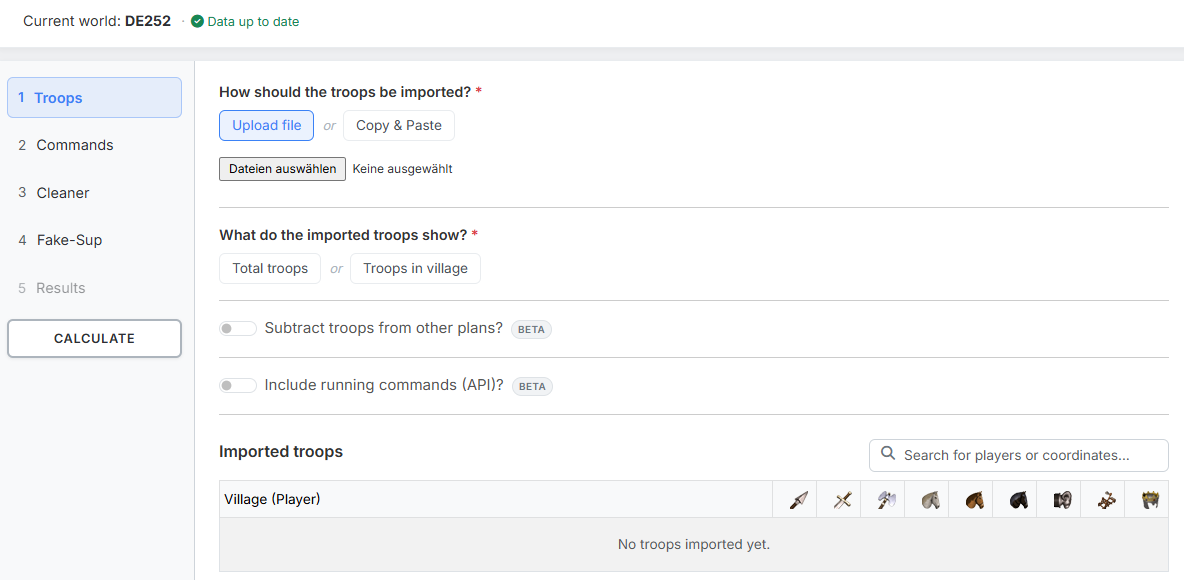
On the left you find the step bar. You can jump between the steps at any time — the tool does not enforce a fixed order. At the very bottom sits the "Calculate" button, which is reachable from everywhere. Step 5. Results stays locked until a calculation has run.
Above the step bar the currently selected world is shown. It comes from the world selection in the main menu — all plans, world data and travel times refer to it.
1. Importing troops
Under "How should the troops be imported?" you switch between two equivalent ways. "Upload file" is preselected; only the way that is currently switched on is visible.
Upload file
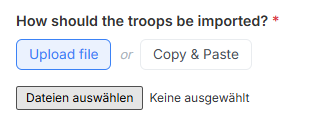
Via "Upload file" you load one or more TXT files. The most convenient way to create these files is the quickbar script "Download Tribe Info".
Expected format:
Coords,Player,spear,sword,axe,archer,spy,light,marcher,heavy,ram,catapult,knight,snob
483|520,Testuser A,2421,6099,100,5963,50,50,3632,200,5,279,0,8
543|538,Testuser A,100,100,6027,100,6,3014,100,100,159,5,0,0
467|559,Testuser A,3779,4836,100,4803,40,50,6309,1584,5,80,0,0
465|523,Testuser B,4298,5495,100,6752,23,50,5761,1131,5,35,0,0
468|515,Testuser B,721,4160,100,2280,61,50,5935,832,5,308,0,4
What matters is the header row: it must contain the word Coords, and the
columns after it must name the units in the same order in which they appear in
the rows. Which units occur depends on the world — on worlds without archers,
archer and marcher simply drop out. The first column is always the
coordinate, the second always the player name.
Copy & Paste
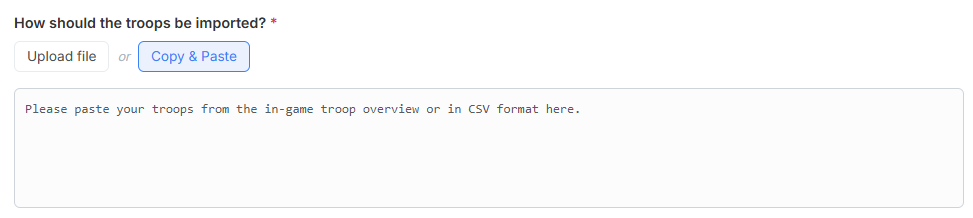
Via "Copy & Paste" you paste the troops straight from the in-game troop overview (Ctrl+A, Ctrl+C). Alternatively the field also accepts the same CSV data as the file upload — header row included.
The way that is switched on counts
File upload and copy & paste are not merged. The tool calculates with whichever way is currently switched on. So if you switch back to "Upload file" after pasting, the file applies again — and vice versa.
2. What do the imported troops show?
This choice is mandatory for both import paths and is not preselected:
- "Total troops" — all troops of the village, including the ones currently on their way.
- "Troops in village" — only the troops currently standing in the village.
When pasting from the in-game overview, the tool looks for exactly those rows that begin with the selected keyword.
Without this choice seemingly nothing happens
As long as no troop type is selected, the tool cannot evaluate the pasted in-game text — the table below then stays empty although there is data in the field. The field is therefore highlighted in red as soon as troops are present and the choice is still missing. If you start the calculation anyway, it aborts with a corresponding message.
3. Subtracting troops from other plans
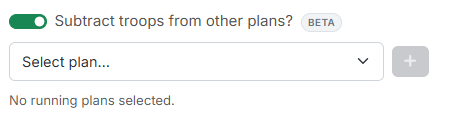
The switch "Subtract troops from other plans?" is the heart of consecutive planning: when an operation is already running, the troops planned there are no longer available for the new plan — yet they are still contained in your uploaded troop data, because you read it out before sending.
Select the running plans in the dropdown "Select plan…" and add them with the plus button. The selected plans appear as a list below and can be removed individually via the red ×. As long as nothing is selected, it reads "No running plans selected."
The tool then works out which units are bound in which village and subtracts them.
4. Including running commands (API)

The switch "Include running commands (API)?" goes one step further than the previous one: instead of calculating from saved plans, it uses the actually running commands that your fellow players have uploaded through the tw-utils API — for instance with a userscript of their own (see Running Commands). That is more precise, because it also covers commands that never came from a plan at all.
Below the switch you see a line such as "API uploads from 12 accounts found and taken into account." — or "No uploads available for this world." if nobody has uploaded anything yet.
The switch only appears if you hold the right to read running commands on a Discord server for this world.
Both switches are independent
You can use them individually or together. Both work in both troop modes — "Troops in village" shows what has not been sent yet, "Total troops" also what has not returned yet.
5. When were the troops read out?
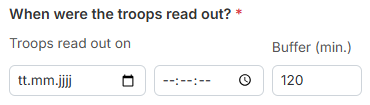
As soon as one of the two switches from section 3 or 4 is active, this shared section appears. It is a mandatory field, because without it the tool cannot decide which commands were already on their way at the time you read out your troops and which were not.
- "Troops read out on" — date and time at which you copied the troop overview or created the file.
- "Buffer (min.)" — a safety window around that point in time, default
120. It absorbs anything that happened between reading out and planning.
Both fields apply to both switches — you only enter them once.
6. Imported troops
At the very bottom sits the permanent table "Imported troops". Per row it shows the village (player) and behind it the units that exist on this world. Use the search field to filter by player or coordinate.
This is how you see immediately whether the import really contains what you expected.
Next up: Step 2: Commands.